Northern Arizona · October 24, 2026 · By Shannon Roberts
Born to Look Up: My Birthday and Flagstaff’s Dark Sky Anniversary
October 24th is my birthday and Flagstaff’s dark-sky anniversary. Celebrate 25 years of the first Dark Sky City through my Arizona astrophotography.
Arizona, Right Now · Part 2 of 5
It’s October 24th, my birthday, and I happen to share the date with one of my favorite things about Flagstaff: the day it became the world’s first International Dark Sky City.
An Arizona astrophotographer sharing her birthday with that anniversary? Honestly, iconic.
Today I’m celebrating both: the city that made protecting the night sky part of its identity, and the woman behind the camera who has made photographing that sky part of hers. Hi, I’m Shannon Roberts. If you know me as @shan.in.az, you already know dark-sky travel is very much my thing.
When did Flagstaff become the first International Dark Sky City? On October 24th, 2001. That makes October 24th, 2026 the 25th anniversary of its designation. My birthday falls on the same calendar date, which feels like an excellent excuse to celebrate with a little cake and a whole lot of sky.
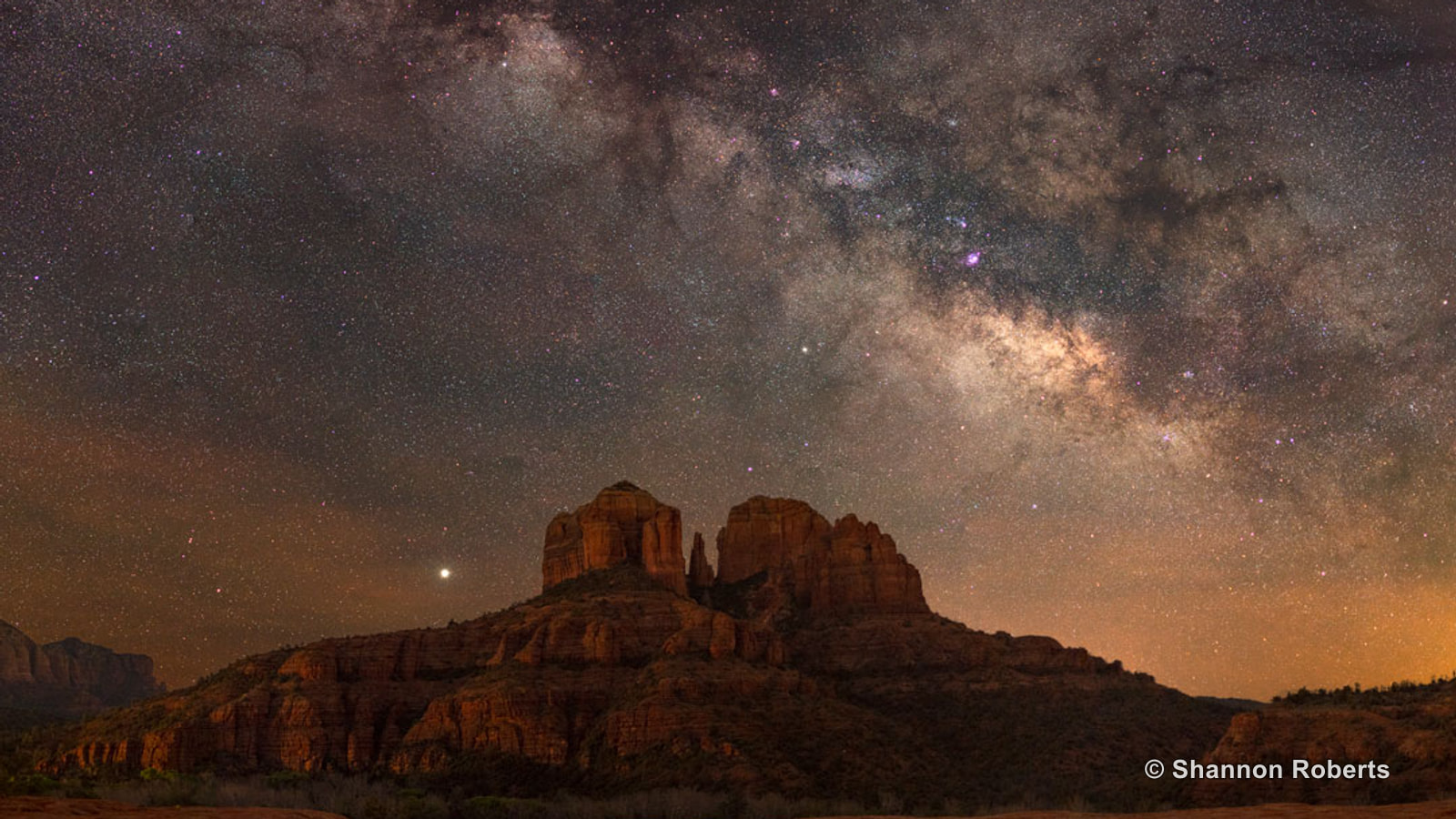
Cover: my Milky Way photograph above Cathedral Rock in Sedona. The photographs in this birthday story celebrate my Arizona astrophotography; each location is identified in its caption.
A birthday moment for the woman behind the camera
I spend a lot of time sharing places worth seeing. Today, I’m also giving myself permission to celebrate the work I create when the sun goes down.
Astrophotography is a part of my work that I’m proud to put my name on. The scale, the color, the familiar Arizona landscape beneath something enormous: that is what I want my photographs to hold. I want the sky to stop you mid-scroll, and then make you want to step outside.
So this is a birthday celebration of my own little corner of Arizona’s night-sky story. The big, dramatic Milky Way images. The landscapes with a personality all their own. And yes, a little main-character energy under the stars. It’s my birthday. I’m allowing it.

Me beneath the Milky Way in Sedona, from my Arizona astrophotography collection. This is a celebration of the photographer as well as the photographs.
Why October 24th matters to Flagstaff
The City of Flagstaff records October 24th, 2001 as the date it received recognition as the world’s first International Dark Sky City. The designation came from the International Dark-Sky Association, now known as DarkSky International.
That milestone recognized years of work to protect the night while supporting a functioning city. Flagstaff showed that homes, businesses, roads and a remarkable sky could belong in the same place.
In 2026, we get to celebrate 25 years of that designation. The anniversary belongs to a community effort: residents, advocates, scientists and people making everyday choices about light. That is a legacy worth being proud of.
The history started well before 2001
Flagstaff’s night-sky protections did not begin with a plaque. DarkSky International’s Flagstaff profile traces the city’s leadership to its 1958 outdoor lighting ordinance and credits the Flagstaff Dark Skies Coalition with the original designation proposal.
It also points to the city’s scientific institutions, including Lowell Observatory and the U.S. Naval Observatory Flagstaff Station. Protecting the sky has practical value for research, as well as for anyone who simply wants to see more stars.
Flagstaff became the first International Dark Sky Place in 2001. Its example helped launch a much wider conservation movement. I love that a city I call home helped show what was possible.
What does a dark sky city actually mean?
It means a community has committed to protecting its night sky through lighting policies and public education. It does not mean every street is unlit, every viewpoint is equally dark, or every evening comes with a guaranteed Milky Way.
The useful distinction is how light is used. DarkSky’s responsible lighting principles focus on light that serves a purpose, stays directed where it belongs, is no brighter than needed, operates only when needed, and uses warmer colors where possible.
For an astrophotographer, those choices matter. A sky washed out by unnecessary light leaves less to work with. For a visitor, they can be the difference between noticing a few bright points and taking the time to really look.

My Milky Way photograph near Prescott, Arizona. Different landscape, same reason to care about keeping our skies dark. Photography © Shannon Roberts.
How I’d celebrate Flagstaff’s dark-sky anniversary
Make astronomy part of the evening
Lowell Observatory is a natural place to start planning, with public astronomy experiences and telescope viewing. Check its current tickets, hours and program calendar before going. Outdoor observing depends on conditions, so give yourself room to enjoy the experience even if clouds have opinions.
For other options, Discover Flagstaff’s astrotourism guide connects visitors with local astronomy experiences. These are suggestions for celebrating the anniversary, rather than a claim that a particular October 24th event is taking place.
Keep the night simple
You do not need a camera to join in. Bring warm layers, choose somewhere you are allowed to be after dark, check the weather and moon conditions, and give yourself time to look up. Keep bright screens and unnecessary lights out of other people’s viewing space.
My Flagstaff and Sedona stargazing guide can help you start planning. Check current access for the location you choose, and remember that a finished astro photograph is not a promise of what your eyes will see on any particular night.
Do one thing that helps protect the view
Turn off an outdoor light that does not need to be on. Aim a fixture down instead of into a neighbor’s window or the sky. Choose lighting thoughtfully. Supporting a dark sky city can be as ordinary as changing what happens outside your own front door.
Here’s to another trip around the sun
Sharing my birthday with Flagstaff’s dark-sky anniversary feels wonderfully on brand for an Arizona astrophotographer. I get to celebrate the work I love, the place I call home, and a community that decided the stars were worth protecting.
Happy 25th dark-sky anniversary, Flagstaff. Happy birthday to me. Here’s to making beautiful images, taking up a little space, and leaving plenty of darkness for the sky to do its thing.
Come celebrate with me on Instagram at @shan.in.az, where I share my photography and Arizona adventures. And if this story inspires one thing tonight, let it be a moment to look up.