Leadership + Coaching · March 7, 2026 · By Shannon Roberts
The Scoreboard Said We Lost. Lacrosse Gave Me Everything.
Shannon Roberts shares how playing and coaching lacrosse built confidence, brought her to Arizona, and helped her find a lifelong chosen family.
Three scoreboards followed me for years: 11–9, 10–8, 11–8. I remember the losses. But lacrosse also carried me across the country, built my first community in Arizona, and taught me that the most important part of coaching begins after everyone forgets the score.

11–8.
I would love to tell you I do not remember the final score of the 2014 Arizona state championship. That I have evolved beyond scoreboards. That I floated away from Grand Canyon University wrapped in wisdom and an immediate appreciation for the journey.
Unfortunately, I am both competitive and in possession of a functioning memory.
Pinnacle 11. Horizon 8.
Pinnacle was the reigning champion. They had won in 2009, 2012, and 2013. Horizon was the underdog, and somehow the group I coached had made it all the way to the title game.
We were three goals away.
Three goals is close enough to feel cruel. Close enough to revisit every possession and make several extremely persuasive arguments to a scoreboard that has never once reconsidered its position.
I did not know that night would be my last game as a coach for a long time.
I did know the particular sting of an almost. Lacrosse and I had been having that conversation for years.
It Started With “Why Not?”
I started playing lacrosse at eleven for the deeply inspiring reason that some other kids at school were trying it.
That is the whole origin story.
There was no cinematic beam of light. No voice announcing that I had been chosen. Lacrosse was a new offering in our town, I had already tried softball and discovered that softball and I had no future together, and I thought, Sure. Why not?
Then I picked up a stick.
Something clicked.
In middle school, I made the A team and got to play with the older kids. I cannot overstate how cool this felt to eleven-year-old me. I was probably unbearable about it in a very wholesome way.
Lacrosse was the first sport that made me feel naturally capable. My body understood it. My brain loved the moving puzzle of it. And for the first time, a sport handed me a version of myself I had not met yet: confident, competitive, and pretty sure she belonged on the field.
That feeling is powerful when you are eleven.
Honestly, it is powerful at any age.
Close Enough to Hurt
In 2004, I played for Anne Arundel Community College under a coach who believed in me. Halfway through the season, I got injured, because apparently the most efficient way to test how badly someone wants something is to briefly take it away.
I fought my way back in time for the semifinals and national championship.
CCBC Catonsville beat us 11–9.
There is scoreboard number two.
I was heartbroken. I was also immediately, stubbornly determined to get better. Losing did not make me want less of the game. It made me want more.
I was named an Academic All-American that season, which I was proud of. It did not magically make losing feel lovely. Apparently pride and disappointment can sit right beside each other without creating any additional legroom.
In January 2005, I transferred to Limestone College in South Carolina. Limestone was small and packed with athletes. You could walk across campus and safely assume that everyone was either headed to practice, leaving practice, or discussing why practice had gone badly.
Our team was close. Not polite-group-chat close. Actually close.
We were nationally ranked and won the CVAC regular-season championship in both 2005 and 2006. In 2006, we beat Pfeiffer 10–8 for the conference tournament title, finished 16–4, and ended the season ranked sixth in the nation.
Then we went to Benedictine University in Lisle, outside Chicago, for the NCAA Division II national semifinal.
West Chester beat us 10–8.
Yes, 10–8 again. Lacrosse has occasionally lacked imagination in the specific ways it has broken my heart.
I loved that team. I loved the strategy, the speed, and the constant mental calculation happening beneath all the running. Lacrosse was a physical game wrapped around a moving puzzle. It demanded that I read people, recognize patterns, change course, and understand that my best decision depended on what everyone else was doing.
Which, in retrospect, is also a fairly accurate description of leadership. And motherhood. And business. And attempting to get multiple children out the door wearing shoes.
I Became the Person With the Clipboard
Because I began at a junior college, I took five years to finish school. During my fifth year, I took classes online and coached at Randolph-Macon College in Virginia.
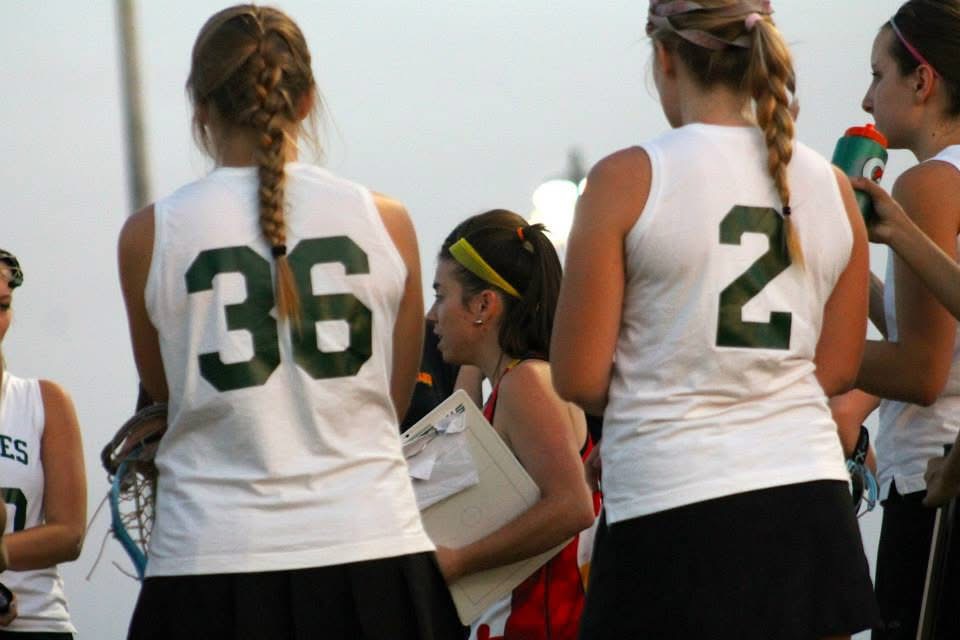
I had crossed over. I was now the person with the clipboard.
And I loved it.
I could see the whole game. I could teach the strategy. Better yet, I could watch a player begin to recognize something in herself that she had not seen before.
After college, I moved home to Maryland and lived in Annapolis. I returned to coach the recreational program where I had grown up playing, which felt like walking back into the beginning of my own story and getting to hold the door for someone else.
I coached club lacrosse and later coached at South River High School. I kept playing too, joining a post-collegiate league that included women from Team USA. This was before every tier of elite women's lacrosse had a polished pipeline, a social strategy, and its own branded water bottle. We all just played in the same league.
The game kept changing shape.
It also kept giving me people.

Eventually, I decided I needed a change. A coaching opportunity brought me to Arizona.
I moved across the country knowing almost no one, which was either brave or unhinged depending on the hour of the day and whether I had recently spoken to my mother.
I coached at Phoenix Country Day School in 2011 and 2012, then at Horizon High School in 2013 and 2014. When I arrived, my Arizona social network consisted almost entirely of people who played lacrosse, coached lacrosse, parented someone who played lacrosse, or owned an unreasonable number of lacrosse sticks.
Those players, parents, coaches, and women from the post-collegiate team became my first invitations and familiar faces. They were the first threads of a community that would eventually hold an entire life.
Then came Sand Storm, the enormous tournament at Empire Polo Club in Indio, in the Greater Palm Springs area.
I arrived with a high-school team, a clipboard, and apparently nowhere to sleep.
The program I was coaching had forgotten to reserve a hotel room for me. It was not mean. It was disorganized. This distinction was emotionally useful but did very little to create a bed.
Then another team stepped in.
Not my team. A team we competed against.
I had coached some of their players in the recreational league. They saw what had happened, folded me into their hotel arrangements, and found me a room.
The opponent became the rescue crew.
On the field, we kept score. In that moment, nobody did.
The activity may introduce you. The people are what make it matter.
Chosen family does not always arrive with a dramatic declaration. Sometimes it looks like a place at the table. Sometimes it looks like the parent who keeps cheering after her own child graduates. Sometimes it looks like the other team saying, We have you.
The Score Was Never the Point
Players forget things.
They forget scores. They forget opponents. They forget the exact inspirational sentence a coach delivered with what she believed was award-winning timing. They may even forget the drill you explained seventeen times, including twice using actual cones.
They do not forget how you made them feel.
I know this sounds suspiciously like something printed over a sunset and reposted by an aunt on Facebook. Unfortunately, it is also true.
Winning matters in the moment. I cared about every one of those close losses. But the scoreboard does not follow us home.
What lasts is whether a player felt seen. Whether she became more confident. Whether you challenged her without making her feel small. Whether she learned that one bad game, one injury, or one mistake did not get to become the whole story.
A few weeks ago, I had lunch with a family I coached with and against ten or fifteen years ago. Their daughter was in high school then. Now she has graduated from high school, graduated from college, reached her late twenties, and is getting married.
This feels impossible, primarily because I have personally aged no more than eighteen months during that time.
Yet there we were, still connected long after the uniforms had been packed away and the scores had stopped mattering to anyone but me.

Leaving the Field Helped Me Return to It
After that 2014 state championship, there were years when I was not actively coaching.
For a long time, lacrosse had been one of the clearest ways I knew myself. Stepping away forced me to figure out who I was without a whistle, a roster, or a practice plan.
I lived. I built businesses. I became a mother. I made mistakes that had nothing to do with a midfield transition. I learned that people are more complicated than any play you can draw on a clipboard, and considerably less willing to run the same drill until they get it right.
It turns out that living an entire life is useful professional development.
None of that took coaching away from me. It gave me more to bring back.
Today, I have accepted the head coaching position for the Northern Arizona University Women's Lacrosse Club. I am also the program director for Northern Arizona Youth Lacrosse and the head coach of the Verde Valley Vortex Youth Lacrosse program in Sedona.
This is apparently what “taking a break” looks like when you are very bad at quitting the thing you love.
At eleven, lacrosse taught me that I could be good at something.
In college, it taught me that heartbreak and failure were not instructions to quit.
As a coach, it taught me that leadership is less about having all the answers and more about what people become while they are in your care.
And in Arizona, it taught me how a place becomes home: one player, one parent, one fellow coach, one unexpected hotel room at a time.
I will probably coach for a very long time.
But this story does not require you to care about lacrosse. Replace it with whatever makes you light up: a sport, a hobby, a creative practice, a cause, or the slightly strange thing you could happily discuss with a stranger for forty-five minutes while they glance repeatedly toward the exit.
Find your thing.
Not because it will make every move easy or protect you from losing. Not because it guarantees a championship, a career, or apparently even a hotel reservation.
Find it because it may lead you to your people.
The scoreboards will go dark. The uniforms will stop fitting. The eleven-year-olds will somehow become adults with college degrees and wedding plans while you remain, obviously, the exact same age.
But sometimes, when you are standing somewhere unfamiliar wondering where you belong, those people will look at the space beside them and make room.